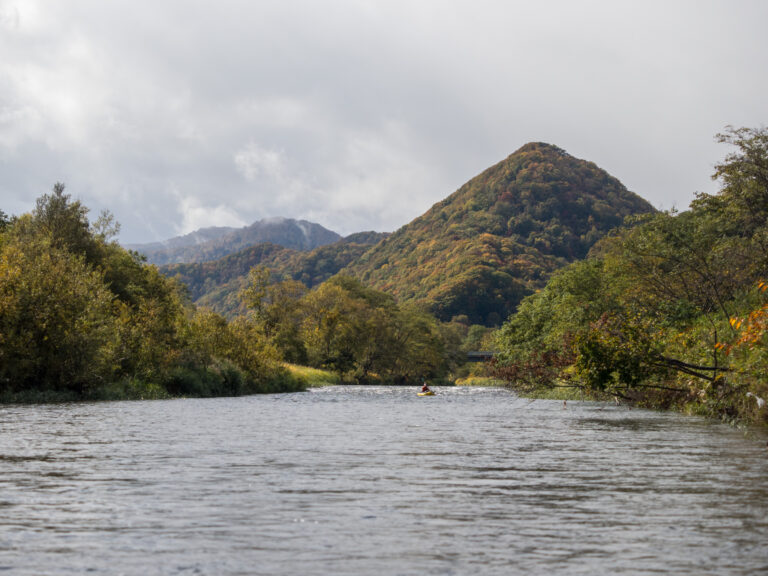

To paddle around Rebun Island, one must get to Rebun Island. One option is to paddle there. This would require either a 45km open-water paddle direct from Wakkanai, or a 20km paddle from somewhere along the Yukuru Coast to Rishiri, a 15km paddle along the Rishiri Coast, and finally a 10km crossing from Rishiri Island to Rebun Island.
We opted for the easier option, the Wakkanai to Rebun Ferry. About 3,500yen each, plus about 1,700yen per sea kayak.
We’d bought kayak carts specifically for this trip, so we packed our kayaks in a parking lot about 300m from the ferry terminal. #gearexplosion

We left the kayaks there as we parked the van at a free parking lot about 10min walk away. We then returned to the kayaks and hauled them to the ferry terminal.
It was our first time to use kayak carts. Fair to say they take some getting used to. They collapsed once or twice, and it was only after a few tries that we got them to stay upright.


We had booked our ferry tickets online, but had to go to the ticket counter anyway, to pay for our kayaks. As mentioned above, each kayak was about 1,700yen one-way. Heartland Ferry doesn’t have a kayak category, so we were just charged bicycle rates.
Being the peak summer season, the check-in counter was busy.

All paid up, we were now able to line up outside in the sweltering heat with the motorbikes. We were the last on, holding our breaths as we pulled our carts over the bumpy loading ramp, hoping they wouldn’t collapse half way up.

The ferry crossing was smooth and calm. So much so that we wondered if we’d missed our chance to paddle from the mainland to Rishiri Island. We knew that our full weather window for paddling around Rebun Island was limited, however, so we pushed those pesty FOMO thoughts aside and just enjoyed the easy route to Rebun.


Somewhat predictably, Rebun’s Kafuka Port area was seething with tourists when we arrived. Early August in Japan is Obon, a time when a lot of people take time off work to either travel or catch up with relatives and visit family grave plots. As such, it’s a very busy time in the tourist calendar.
We took refuge in the shade in a small park next to the ferry terminal and ate our pre-packed lunch (Haidee’s home-made rye bread with peanut butter and jam). After a quick re-pack of the kayaks, we started the 800m walk along the port frontage road to the nearest put-in. This put-in was a quiet fishing port ramp, perfect for a quick launch.
The weather was forecast to be calm, so we opted to just strap the kayak carts to the back decks of our kayaks, so we could get on the water as quickly as possible. We’d figure out how to pack them into our kayaks later!
We should note here that technically, a Hokkaido-wide bylaw prohibits pleasure boats (including sea kayaks) from using fishing port facilities unless in an emergency. For this trip, we actively chose to ignore this bylaw. Much of Rebun’s east coast is so fortified by a small nation’s quota of concrete, that the fishing ports appeared to be the only option for landing and launching.


As we pushed off from the boat ramp, Mt. Rishiri was standing clear in the distance. A relative rarity, so we were feeling lucky.

Our original plan for the paddle today was to end up 11km north of Kafuka Port, at the small settlement of Nairo. The idea was to camp there at the port, near the public toilets.
We still had plenty of time in the day, however, and we figured we may as well get this more built-up eastern coast section over with sooner, so we decided to keep on going to the next port along the coast – Higashi-uedomari. On Google street view, I’d spotted some permanent-looking porta-loos in the port area, so we’d theoretically be OK for toilet access, and I was sure we’d find somewhere to pitch a tent.

The coast here was built up as predicted, but it was nice to be on the water. Of course, a sense of remoteness and harshness was present, as one could expect from Japan’s northernmost island.
We dropped in on Nairo port, and were happy to be able to fill our 10 litre water sack. We weren’t expecting any water source at Higashi-uedomari.
As we were getting ready to push off from Nairo port, a local pulled up and had a chat. “You’re heading around the island?” he asked incredulously. “That sounds like hard work, but fun!”


Overall, our impression of the locals so far was good. Some would stand in the doorways of their houses, watching or waving as we paddled past.

For the entire paddle today, we had Rishiri Island in our rearview.

We pulled into Higashi-uedomari port at around 4:30pm. The large plastic bunk boards on the boat ramp were a god-send for pulling our heavily loaded kayaks up.

We wandered around a bit, trying to figure out the best place to pitch our tent for the night. After a while, the best spot appeared to be what seemed to be a disused kelp drying bed.
Luckily, there was a fisher tending to his boat on the ramp. I asked whether we’d be getting in anyone’s way if we camped there for the night.
“Well, no one uses that kelp gravel any more, so I’m sure it’d be fine,” he said cheerily. “You might get woken up at 4am by fishers getting their boats ready though!”
We took that as the permission we needed, so got set up for the night.

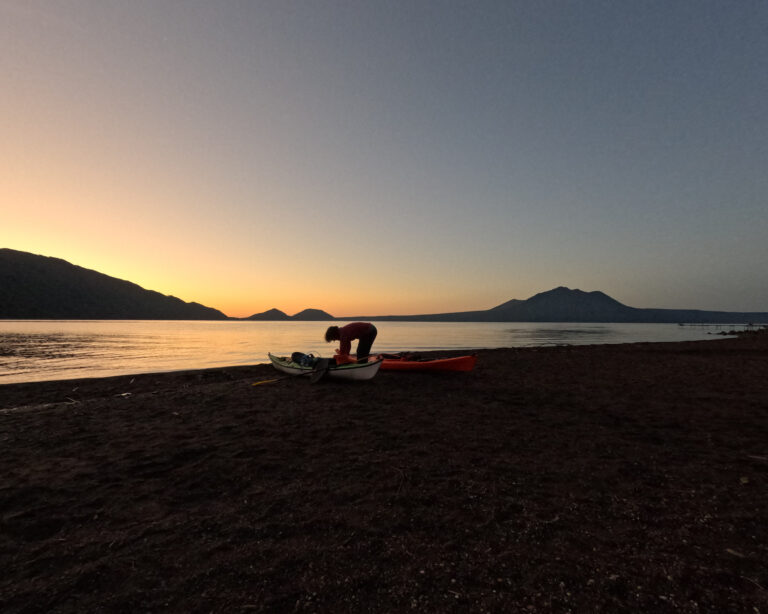
For dinner, we had one of our dehydrated meals, and watched the sunset dye red the clouds over Rishiri.
We set our alarms for 2:30am, so we could get away from the port before the morning commotion of fishers setting off.