The old fisher the day before had warned us that Higashi-uedomari port would be buzzing with activity early this morning. “They’ll all be fussing about with their boats from around 4am,” he said.
Given this information, plus the fact the weather forecast was suggesting a beautiful sunrise, we decided to get away before the morning fishing boat chaos. We set our alarms for 2:30am, and were in our sleeping bags by 7:30pm.
When the alarms went off, it was still very dark outside. We busied ourselves with getting things packed up though, and gobbled down a quick breakfast snack of pre-packaged hotcakes. We would aim to have a proper breakfast once we got to the campground at Funadomari, about 1.5hrs paddle away.
In the end, we were pushing off the boat ramp at around 4am, just as the sun was threatening to emerge over the horizon.
Just as I was about to push off, the first fisher arrived. Perhaps late 20’s. Afro-like hair, pulled up high on his head with a head band.
“Looks like good weather,” I said.
“It sure does,” he replied. “Perfect for the last uni sea urchin harvesting day of the season.”
He explained that the local fishing coop had laid down rules for the sea urchin season, and that everyone was happy they were able to get out in such good conditions for the last day.
“Just a few days ago, this entire coast was so rough we couldn’t get the boats out,” he explained.

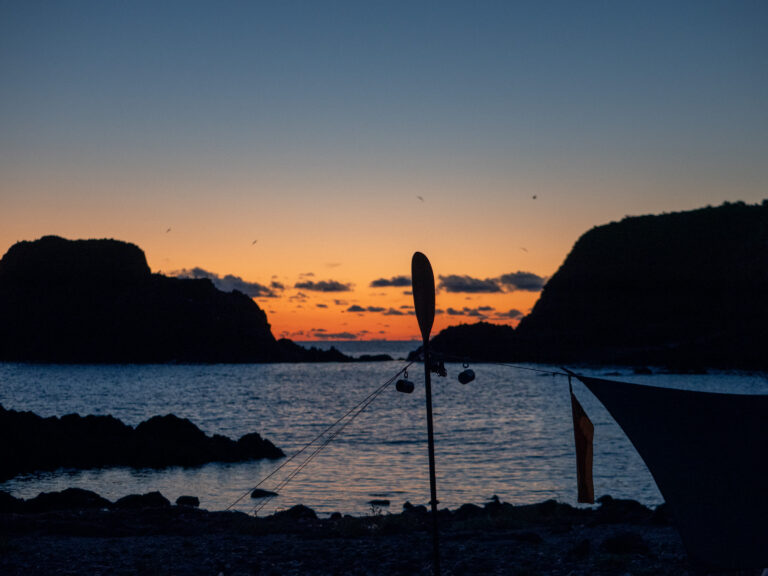
Haidee and I pushed off, and rounded the sea wall to be greeted by an epic sunrise. It would last for about an hour as we paddled, dying the sky and clouds with a variety of hues of red, orange, and purple.


At about 4:30am, the sea urchin harvesters launched their skiffs, and the entire area was a buzz of activity. Haidee and I kept close to shore, in the shallows, to avoid being in anyone’s way. We were lucky the conditions were so calm, and even then, we were being caught out here and there with rouge waves, crashing over our bows. Had the sea been up at all, we would have struggled to keep in the shallows, and hence would have been paddling where the skiffs were zipping about.


It was only once we had enough light that we noticed all the seals. We were surrounded by them. They were mostly indifferent to the skiffs, but extremely curious about us.
Seals would become an almost constant presence througout the day.


The first port of call for us today was Funadomari Bay. We’d visited there before, about 12 years ago, on our bicycles. So we knew the campground there would be a nice oasis to catch up on sleep, and have a proper breakfast.
First, we had to round the first of a number of major capes on this Rebun Island sea kayak circumnavigation, Kanada-no-misaki 金田ノ岬. It was here that we first got a glimpse of Todo-jima Island トド島. This uninhabited island has occupied my imagination for a while, as the north-facing bay looked perfect for a very remote wild camp.

We were also taken aback by the massive fortifications erected around the numerous fishing ports in the area. They spoke to how wild the conditions must get here, particularly in winter.


And of course there were more seals. Still ever-curious of us, the intruders, on our strange watercraft.

The uni sea urchin harvesters were also still at it. They lean over the edges of their narrow skiffs, using small electric outboard motors to move around an area. With a glass-bottomed viewing box, they spy the urchins they want. They then use long poles with a strong wire-rimmed net attached to the end of it. Using this, they can scoop the urchins off the rocks, gathering a few dozen in the net before hauling them up onto the skiff.
The urchins are certainly easy pickings around here. The rocks are teeming with them. The bright orange roe, especially that from the Rishiri and Rebun areas, fetches a premium price – around US$50 to US$75 per 100g.

Once again, today we were treated to a clear view of the summit of Rishiri-zan 利尻山 (1721m).

As we paddled into the expansive Funadomari Bay, we were both feeling the effects of only 6 hours sleep, and only a bite to eat for breakfast. We were both ready to get to the campground, set up the tarp, have some food and a rest, and then plan the rest of our day.
Indeed, we could either just stop here and have the rest of the day off, or make the most of the weather window and head to Todo Island.
Either way, we decided that no decisions would be made until we had food, coffee, and a nap.

With the sun now high in the sky, it was shaping up to be another swelteringly hot day. We hurried to get to the campground – a 300m walk from the beach – and get the tarp set up for some shade.


All up, we spent about three hours at the campground. The decision was made to check out Todo-jima Island. From the Google Satellite images, it looked like the north-facing beach would be suitable for a rough camp, but we couldn’t be sure. We knew there was no water source on the island, so we made sure to fill up our large 10 litre water sack and all other receptacles we had on hand.
Once we were back on the water, it was a beautiful paddle along the sandy beach coast of Funadomari Bay. The water reminded us of Okinawa. Blue, warm, and windswept. True to the weather forecaster’s word, there was now a stiff westerly blowing. The low hills of Sukoton Peninsula didn’t do much to block the wind, so we spent about 45 minutes paddling into a stiff headwind.

After a 45 minute paddle into the wind, we finally got into some leeward conditions. The stiff westerly was somewhat of a concern for the 1.5km crossing to Todo-jima Island, but we figured we could make decisions once we got closer to Sukoton Cape. In our favour was the fact that there was a line of reefs most of the way to the island, behind which we would likely get shelter from any westerly seas.
Again, we were sharing the bay with seals.

And we continued to be taken aback at the colossal fences on port walls.

The scenery was very Rebun-esque. Low, green hills. Expansive sky. Windswept sea.

Before pushing on to the crossing to Todo-jima Island, we stopped in at a shady cove to have some lunch. Again, it was Haidee’s world-famous-in-Hokkaido homemade rye bread sandwiches with peanut butter and jam.

With lunch-break over, it was time to take a look at the 1.25km crossing from Cape Sukoton to Todo-jima Island. Despite the stiff westerly, it was looking perfectly doable, especially with the micro-lee conditions on the eastern side of the reefs.
The entire crossing is little over 2m deep, so the ultra clear water was especially beautiful, with aqua blue tones.


We made short work of the crossing. First impressions were that we were now on an island that belonged to the birds. The birds appeared to be quite curious of, and very wary of, us the visitors.

A quick paddle around to the northern side of the island confirmed what the satellite images had suggested. The small spit-like feature in the middle of the bay would be perfect for pitching a tent. Well within the lee of the westerly, it was deserted-island vibes perfection.
We quickly got a tarp set up (with skills gleaned from Mick and Timbah on last year’s Shiretoko expedition), and promptly spent the rest of the afternoon snoozing in the shade and swimming to cool off.


Somewhat surprising to us was to see burrows in the hillsides. Clearly bird-nest burrows, similar to the Rhinoceros Auklet burrows we’ve seen elsewhere in Hokkaido. Here and there, we saw what appeared to be research stations on the hillside.


Once again, as we prepared our dinner under the tarp, we remarked how carefree paddling on Rebun felt compared to places like Shiretoko. The reason being that there are no bears, nor foxes on Rebun Island. No bears to sniff out food, and no foxes to run away with gear left outside. Pure luxury!
After a very hot afternoon, we were relieved to see the sun dip below the low hills on the island. We bedded down early, and set the alarms for 3:45am, with the aim to get on the water by 5:30am. The weather forecast on my Garmin inReach was suggesting another clear but hot day tomorrow, so we wanted to get away early to beat the heat.