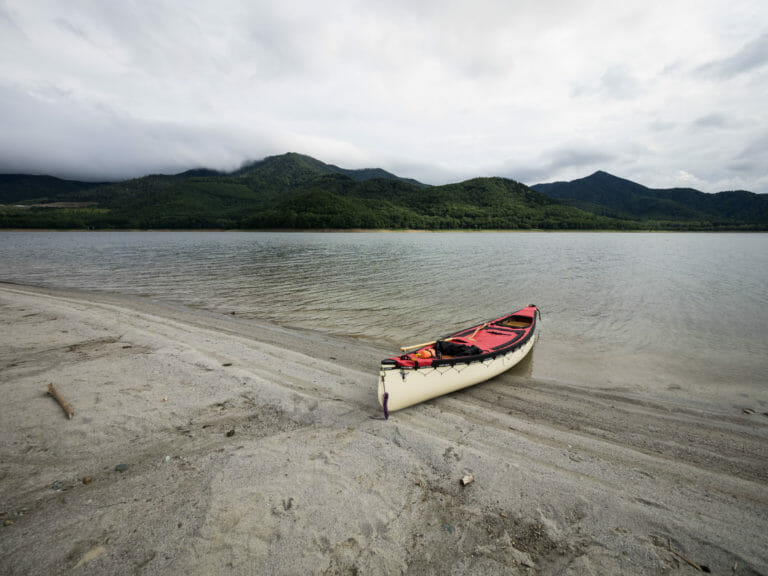

On Day 3 of our sea kayak circumnavigation of Rebun Island in northern Japan, we wanted to get away early, to beat the heat of the day. So, we were on the water by 5:30am. By that time, a local uni sea urchin harvester had arrived at Todo-jima’s northern bay.

Yesterday, we had arrived at the island from the east. This morning, we exited via the island’s west side. There was some leftover chop in the sea state from yesterday’s westerly, but there was no wind. Perfect early morning paddling conditions.


As we rounded the southern side of the island, Rishiri-zan’s peak was again clearly visible on the horizon. Once again, we were pinching ourselves at having so many days in a row where we could see the peak. Normally, we’d consider ourselves lucky to see it one day out of seven.

The 1km+ crossing back to Rebun Island was straight forward. We were now on the much anticipated west coast of Rebun Island. This is the coast most sea kayakers (not that there are many of them) come to Rebun to see. No roads run the length of the island, and settlements are few and far between. We were expecting expansive beaches, high cliffs, and remote coves.


And that’s what we got. Gotota-misaki Cape and Gorota-hama beach were a highlight.

Quintessential Rebun scenes. Sea, hills, sky.

This carried on until we got to Nishi-uedomari. A small tourist-trap, with a lookout and a small building housing a small eatery.
Just as we pulled up, two large tourist buses arrived. Quintessential mass tourism. A flag-waving attendant at the front of a gaggle of squinting travel-weary visitors, pointing out some of the more novel sea-level alpine flowers endemic to Rebun Island. The first four or five tourists paid attention, while the other 50 behind them followed in others’ footsteps.
We filled our 10-litre water sack, bought a battered potato, and quickly carried on our way.


We would now be away from any road access to civilisation for the next 30km or so. Here and there, the length-of-Rebun hiking trail would drop down to the coast, but overall, we’d be on our own.
The high cliffs continued. Here and there, small waterfalls cascaded down from what we can only imagine are springs.


As the day wore on, the north-northwest seas started to build. We knew we’d get some conditions from the north, but we’d expected we would get protection from them as the coast veered to the southeast. This protection didn’t come, so we spent the last hour or so of the paddle dealing with quartering following seas. This was somewhat tiring, always correcting the direction of our boats as they got pushed about from behind.
Arrival at Anama-iwa Rock, therefore, was a welcome relief. Just as Google Satellite had promised, this was a perfectly sheltered oasis, replete with a freshwater stream.

When we arrived, there was a group of middle-school kids taking a break on the beach. I asked them where they were walking to.
“All the way to Motochi,” they replied cheerily.
Their adult handlers looked somewhat less cheery, clearly not used to walking such a long way. To get to Anama-iwa Rock on foot was at least a three-hour walk.
Once we had the tarp set up, at least four or five other parties dropped down from the hills to the beach, and all carried on along the coast towards Motochi.
By 4:30pm, we were the only ones to remain on the beach.
I sent the drone up for some shots of the coast.
Looking north, from the way we’d come, we could see the high cliffs we’d paddled beneath.

Looking south, we could see the coast we’d continue on tomorrow, along with Rishiri still visible in the distance.

It was curious to think where on earth the stream we were camped by came from.

With such an early start this morning, it was only 2pm when we arrived at Anama-iwa Rock. The sea was a bit too lively, and distances tomorrow too short, to warrant carrying on, so we just spent the remainder of the day lounging under the tarp, and later in the shade of Anama-iwa Rock.


Like elsewhere along the coast, there was no cell reception at Anama-iwa Rock. I woke my Garmin inReach up, and requested a weather forecast. True to Windy.com’s word three days ago, tomorrow was forecast to be dead calm. We were in for another day of perfect paddling conditions to end the trip.
We only had about 18km to paddle to finish the full circumnavigation of Rebun island.
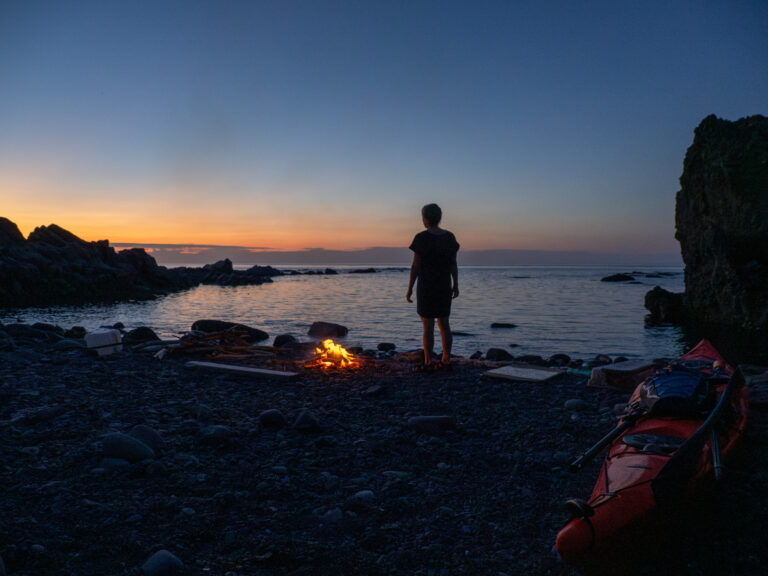
As we watched the sun set over the Sea of Japan, little did we know that those plans would change quite dramatically.