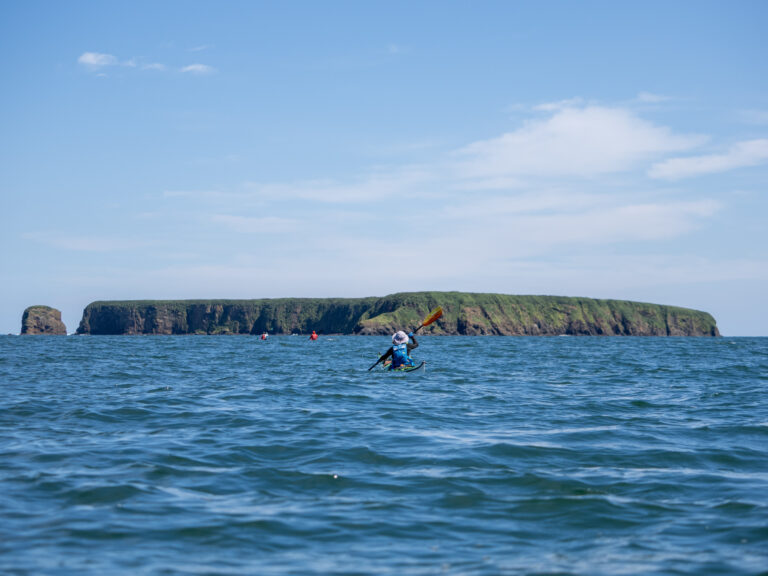
We were again on the water at 5:30am this morning, simply to make the most of the shade of the high cliffs here on the west coast of Rebun Island. The forecast was for a clear, calm day, which meant it would likely be very hot again in the full sun.
As we pushed off from the campsite perfection that is Anama-iwa Cove, we were once again dwarfed by the enormity of the cliffs and landscape.


Soon after setting off, we passed by the sleepy port settlement of Uennai, only accessible by boat or on foot. The place had clearly seen better days, with buildings in various states of disrepair.

The far-north-latitude forest-scape continued, with stunted trees dotting the tops of the cliffs.


We soon found the world-famous in Rebun, Rebun-taki Falls. The falls were nice enough.


More interesting, however, was all the flotsam. It was all very international. We found Japanese, Korean, Chinese, and Russian.

The world-famous-in-Rebun locations kept coming. This time, it was Jizo-iwa Rock. A large, mostly free-standing rock. There was even a viewing platform for the landlubbing tourists.

The conditions were flawless. Perfectly calm seas. Pleasant temperatures.
Soon we arrived at Motochi, the only other road-access settlement on Rebun Island. It’s connected to the eastern side of the island by a 2.5km tunnel.
We were too early for the cafes, so we took a stroll, filled up our water bottles at the public toilets, and watched as kelp harvesters laid out their haul to dry in the sun. Unlike elsewhere we’ve seen (such as Cape Erimo), here on Rebun, kelp was being covered with plastic nets when drying. We asked why.
“It’s often windy here, so it helps keep the kelp in its place. Also, it helps to make the kelp dry flat,” we were told.


The impossibly perfect paddling conditions and vistas continued past Motochi too.


As we were approaching the southernmost section of Rebun Island’s west coast, we came across the first colony of seals we’d seen since leaving Funadomari Bay a couple of days ago.

At around 11am, we pulled into Shiretoko Port. It appeared Haidee had been thinking the same thing as I had been thinking, ever since seeing Rishiri this morning as we rounded the southern end of Rebun.

“It really doesn’t look that far,” she said.
Indeed, the 10km crossing looked mightily tempting.
We decided to postpone any decision about the crossing, however, once we’d checked the weather again, and had some lunch. Doing the crossing, after all, would mean we’d forgo doing the full circumnavigation of Rebun.
After lunch and consulting the weather, however, we decided it was worth giving up the full circumnavigation (by about 10km), and instead jump on the opportunity to paddle the 10km crossing of Rebun Strait to Rishiri Island.
Some things we considered were wind, current, and time of day. Wind was just OK. A breeze out of the north-northwest, forecast to gust at 20km/h by 1pm, but die away by 3pm. The current through the Rebun Strait is at most 1 to 1.5knt, flowing northeast, so entirely manageable. Time of day was also manageable. It was noon when we would set off, so considering a paddling pace of around 6km/h, we should be able to complete the crossing in under two hours.
We set off from Rebun with some trepidation, on a bearing of 130°.

It was about 1/3 of the way across that we encountered a moderate swell from the northeast. This, combined with a moderate wind chop from the northwest made for interesting but manageable paddling conditions. Even with skegs down, we needed to use corrective strokes here and there to keep on bearing.

We arrived on Rishiri Island just after 1:30pm. Our longest crossing to date was a success. We pulled up on a small boat ramp, ate some snacks, and had a 30-minute nap in the shade of one of the boats on the ramp.

We hadn’t thought all that much about what we’d do once we got to Rishiri. A quick consultation with the weather forecast confirmed what we already knew – the forecast for the next week ruled out an attempt at paddling around Rishiri. It was strong wind almost every day. We’d used up a very fortunate weather window on Rebun, so Rishiri would have to wait for another time.
The forecast for tomorrow was good though. A strong southwesterly was forecast, which put the northeast side of the island well within the lee. Therefore, we decided we would just paddle the 10km or so from where we landed, to the Oshidomari Ferry Terminal on the northeast side of Rishiri.
Once we were on the water, we were reminded of how incredibly volcanic Rishiri is. Basaltic lava rocks lined the coast.


We’d already paddled 25km today, so we were keen to find a spot to camp for the night, and complete the remaining distance to the ferry terminal the next day. Finding a spot to camp where we’d 1) be out of people’s way, and 2) we could call a taxi to take us to an onsen, was more difficult than we expected though.
Rishiri was much more touristic than Rebun, so we were, perhaps more than necessary, quite on edge about camping in ports or on private land. Beaches were non-existent, much of the land immediately adjacent to the coast was made up of gravel kelp drying beds, and old decaying buildings took up the rest of the space.

From the water, I gave Rishiri Greenhill Hostel a call. I knew there was a path from a rocky beach up to their hostel, so if we were lucky, I figured we might be able to get a dorm room bed for the night there. We’d have to be very lucky though, since this was the height of the summer break season in Japan.
Sure enough, they were completely full.
“I don’t suppose we could pitch a tent in you back yard?” I asked.
“I’m sorry, but that wouldn’t really work,” the front staff replied.
I thanked her for entertaining the request, hung up, and we continued our search.
About 10 minutes later, however, I got a call back. It was Yoshi, the owner of the hostel, someone I’d met a number of times previously, and for the first time seven years ago when a few of us visited Rishiri for backcountry skiing.
“We had a chat about it, and since you must be very tired from your crossing, please do come and pitch your tent in the back yard. Sorry we can’t offer you anything else!” he said, in his signature cheerful way.
I thanked him profusely, and we carried on around the coast with a new sense of purpose. We’d need to paddle another 6km or so, but at least we knew we’d have a nice grassy backyard to camp on, with access to facilities.


As we approached from the water, I recognised the hostel that I’d stayed in several times. The ‘beach’ was rockier than I remembered, but that was probably just because the last time I had seen the beach, I wasn’t trying to haul a fully loaded kayak up it. Direct access to the hostel’s backyard was a dream though, with a nicely mowed trail.
We lugged up our camping gear and food. Went and said hello (and thanks!) to our friends at the hostel. Had one of our dehydrated meals each. Called a taxi and went to the Rishirifuji Hot Spring onsen for a well-deserved soak.
Thank you so much to Yoshi and his family for letting us stay in their backyard, despite it being the peak tourist season! (I shouldn’t be surprised…just take a look at the reviews on Google – such a hospitable family!).