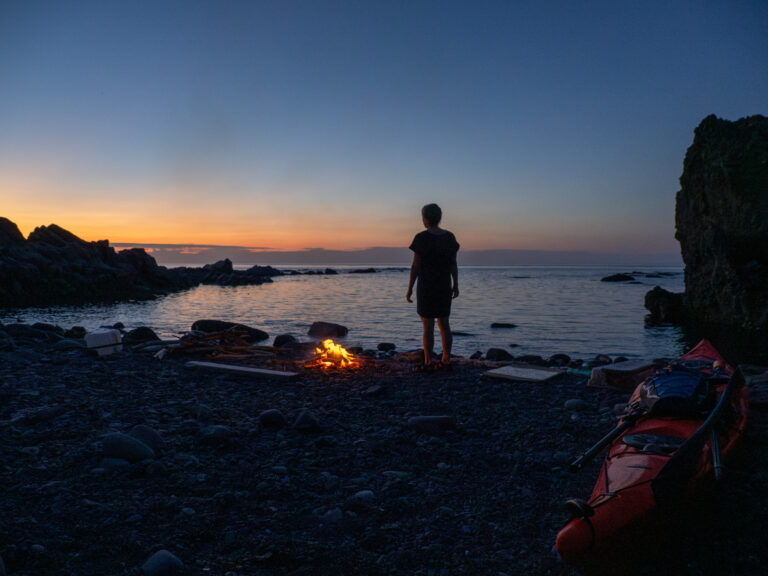
With only four or five kilometers to paddle today, we indulged in a sleep-in till 5:30am. After three nights on rocky beaches, the grassy backyard of Rishiri Green Hill Hostel was a dream.
We indulged in their offer of using the hostel’s common room and kitchen. Pure luxury.


By 7am, we were packed up and heading back down to the kayaks. True to the weather forecast, today’s weather was calm on this side of the island. A strong southwesterly was blowing, but the massive bulk of Mt. Rishiri was keeping us in the lee.


We said our goodbyes to Yoshi and the crew at Rishiri Greenhill, and headed on our way.
First, we paddled back the way we came yesterday, to check out Ponmoshiri Island ポンモシリ島. We’d paddled past it yesterday, but were too tired after the nearly 40km paddle to be bothered checking it out properly.
As we paddled along the short 700m section of coast to the island, I couldn’t help but be amazed at the volcanic rock.


The amazement continued at Ponmoshiri Island. From land, the island appears to be only a blob of rock. Paddling around the seaward side of it, however, revealed a tiny cove, rimmed with dramatic ramparts of volcanic rock.
Hardly incidentally, this is the section of coast where the likes of Toshiya Watanabe and Rishiri Activity do SUP and sea kayak tours.


Ponmoshiri Island was being dutifully guarded by hordes of passionate gulls.

Beyond Ponmoshiri Island, I had once again underestimated the grandeur of the rest of the short paddle from Rishiri Greenhill Hostel to the ferry terminal. This short paddle was some of the more dramatic scenes of the whole five days, with high cliffs continuing all the way to the ferry terminal.


Each small cape we rounded was a labyrinth of small waterways and rocky outcrops.


In between were neat rows of houses, boat ramps, and fishing huts.

And then more high rocky outcrops.

As we rounded the final cape before the ferry terminal, Mt. Rishiri stood clear in the sky.


For our final take-out spot, we had decided on a boat ramp on the far side of Oshidomari Port. So, we stopped for a few moments to look up the ferry timetables.
“The next ferry out of here is at 12:05, so we’re all good. It’s only 9:25am,” I declared with great confidence. “We should be safe to cross the port.”
No sooner had I made the declaration and we started paddling towards the entrance of the port, than a large foghorn sounded, and a massive ferry started departing.
I had missed the 9:30am ferry going from Rishiri to Rebun. Scary!

With that excitement out of the way, we paddled across the port to the boat ramp. Our five-day paddle around and among Rebun and Rishiri was done.

Well, almost done. We still had to get the boats and all our gear from Rishiri to Wakkanai, where we’d left the van five days ago. We booked our ferry tickets online, but we’d still need to pay for the kayaks (about 1,700yen each).
So, we busied ourselves with getting the boats ready and on their carts.

We didn’t get too many strange looks, and Mt. Rishiri continued to watch over our progress.

The public toilets in front of the ferry terminal were a perfect place to get water to rinse everything off.

After paying for our kayaks, and getting some amazing coffee and bakery treats from PORTO coffee, we lined up with the motorbikers.
We were the last to be let onto the ferry.
On the ferry trip five days ago from Wakkanai to Rebun, we’d been a bit concerned with how tightly the ferry staff had strapped down the kayaks. They had been lashed to the ferry deck with heavy-duty ratchet straps almost as tight as they would go. On Haidee’s boat, the strap was strapped down hard over the cockpit coming. My boat being plastic, the hull had deformed spectacularly over the cart supports. It returned to its shape over a day or two, but it was a little concerning.
So this time, I asked them to only use the least amount of pressure required to keep the kayaks in place, and hoped for the best.


Once on board, we had some of Haidee’s amazing homemade dehydrated hummus, plus some croissants, for lunch.


The ferry ride was 1h 40m. Oshidomari Port was well within the lee of the strong southwesterly, but once we got out of the lee, the sea was a mess of crashing waves. We couldn’t help but imagine what it might be like to be out in that on a kayak.
Once we arrived in Wakkanai, we headed down below deck to retrieve the kayaks. The crew seemed to have taken my request for a light touch on board, and had gone out of their way to baby the kayaks. I had intended to only ask that they use less pressure on the heavy duty rachet straps, but they clearly had other plans.


Once all the cars and motorbikes were let off the ferry, we were finally allowed off. We rolled our kayaks to an out-of-the-way spot. Haidee went to fetch the van, while I unloaded everything, ready to pack things into the van when she returned.
Done and dusted, a really worthwhile exploration of Rebun Island and a very small section of Rishiri Island.