
WORD FROM THE AUTHOR
Backcountry ski search and rescue in Hokkaido is settling into a new “normal.” The high proportion of foreign backcountry casualties, bandied about in the Japanese media, is no longer clickbait. Foreigner-involved lift-access backcountry incidents have reached record levels, and, likely, this season will again set a new high. And as long as the yen remains weak and Hokkaido continues to offer the world’s best powder, this new normal will keep consuming substantial responder time and resources in ski-area hotspots.
Non-lift-access backcountry, however, tells a different story. Despite a visible increase in overseas ski tourers, the number of SAR callouts in the non-lift-access backcountry has not surged. What has changed, however, is the snowpack: avalanches are now accounting for a large share of non-lift backcountry incidents—something that was not true six years ago.
This post is data-heavy, and parts of it are certainly sobering. At the same time, the data also suggests that Hokkaido’s incredible powder can be enjoyed safely with appropriate preparation, knowledge, and experience. Get informed—and then get out there and enjoy it.
Rob Thomson (Robert Thomson)
Editor-in-Chief, HokkaidoWilds.org
Associate Professor, Department of Global Innovation, Hokusei Gakuen University
KEY POINTS
LIFT-ACCESS BACKCOUNTRY – Accounts for 79% of all callouts SAR callouts in Hokkaido. On average, 60% more foreigners than Japanese are involved in lift-access backcountry search and rescue callouts, with this trend continuing. Getting lost is the main cause of lift-access search and rescue callouts.
NON-LIFT-ACCESS BACKCOUNTRY – There are 75% fewer non-lift backcountry search and rescue callouts than lift-access callouts. More Japanese are involved in non-lift backcountry search and rescue incidents than foreigners – avalanches, falls, and getting lost cause most callouts. Outcomes are grave for non-lift backcountry incidents.
OTHER WINTER ALPINE ACTIVITIES – More Japanese tend to get into trouble – getting lost and falls are major causes.
RISK INFERENCE – Based on current backcountry participation statistics, foreigners are not higher risk in the backcountry. It’s limited, but official backcountry entrant data is now available.

EXECUTIVE SUMMARY
- The vast majority of backcountry SAR callouts are for lift-access incidents. Across the 2015–2025 winter seasons, lift-access backcountry accounts for 79% of all backcountry-related SAR callouts in Hokkaido (340 callouts involving 501 individuals, out of 429 callouts involving 611 individuals total; see Fig 1).
- Winter 2024 set a 'new normal' for foreigner lift-access incident numbers (Fig 1). In the 2024/2045 season, foreigner lift-access backcountry incidents jumped to 51 callouts / 71 individuals, far above earlier peaks before the pandemic. This accounts for media reports of "80% of backcountry callouts involve foreigners." The 2025/2026 season is set to continue this trend.
- The risk of being involved in a lift-access backcountry incident is probably the same among foreigners and Japanese. Lift-access callouts follow lift-access skier citizenship demographics; about 85% of all lift-access backcountry entrants are foreign, and about 85% of lift-access incidents involve foreigners (see the discussion here).
- The main cause of lift-access backcountry callouts continues to be 'getting lost'. “Getting lost” accounts for up to 58% of lift-access callouts (Fig 2).
- Non-lift backcountry callouts remain comparatively small-volume. Foreign non-lift-access backcountry callouts are usually around 3 per year but rise to 5 in 2023–2024; Japanese callouts are typically around 6–10 per year (Fig 4).
- Non-lift backcountry outcomes are serious, especially for foreigners. While incident numbers may be small, in the 2015–2024 non-lift outcome chart (Fig 6), foreign death/missing is about ~22% (6/27)—a strong contrast with lift-access backcountry.
- Non-lift “risk” can’t be inferred from victim nationality alone. Japanese make up most non-lift victims (Fig 4), so it's tempting to say Japanese are higher risk. But incidents are more geographically dispersed for Japanese, while foreign incidents cluster near popular zones (Fig 4b). Restricting analysis to those popular zones, per-entrant risk looks similar between foreign and Japanese.
- Avalanche has become a major cause of non-lift backcountry callouts, compared to pre-pandemic data. For foreigners, avalanche is the largest cause share; for Japanese, avalanche and falls sit alongside “lost” as major contributors (Fig 5).
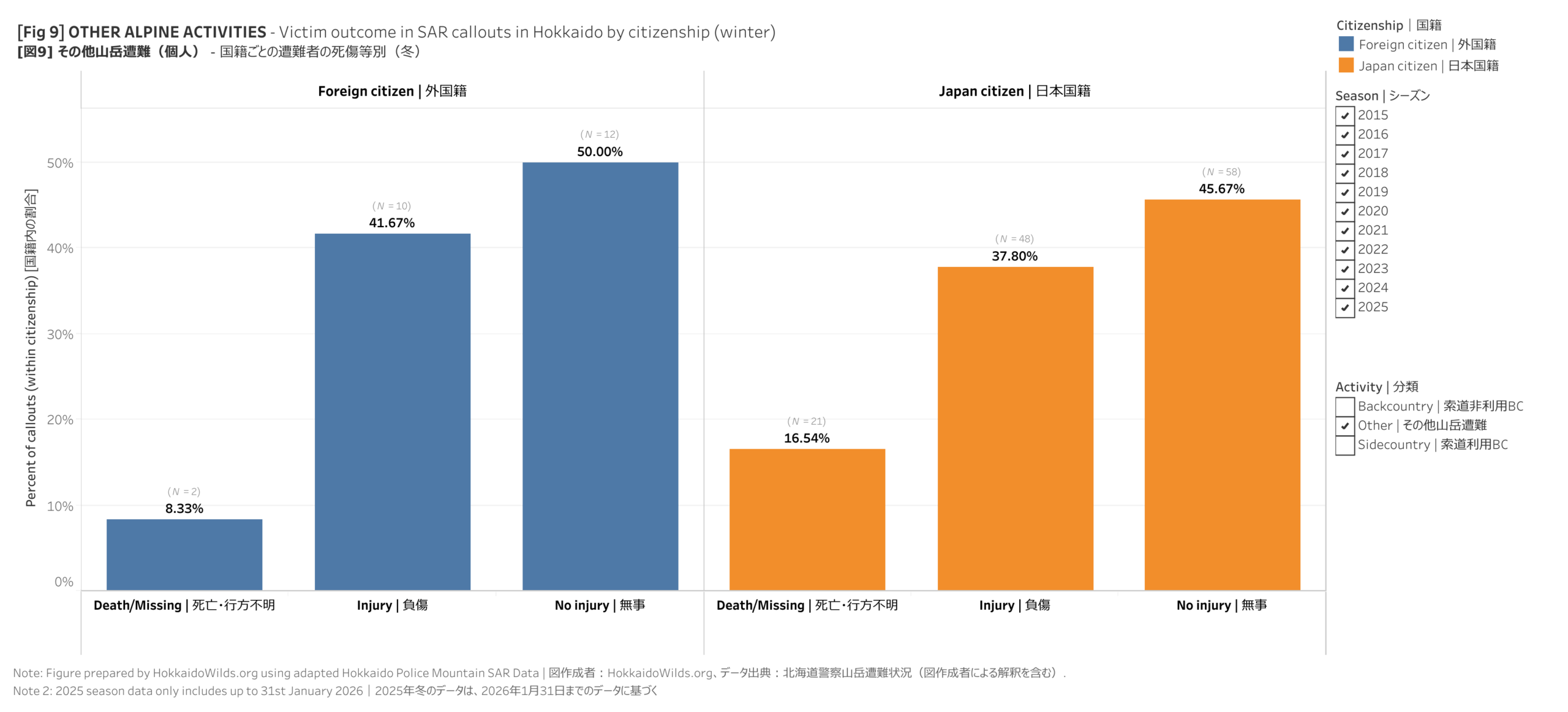
- “Other alpine activities” is still a large driver of Japanese winter mountain incidents. Japanese “other alpine” hits 20 callouts / 25 individuals in 2022 (Fig 7); its outcomes also show relatively high death/missing (Fig 9) compared with lift-access backcountry.
- Lift-access backcountry incidents skew towards snowboarders, non-lift incidents towards skiers. As per Fig 11 and Fig 12, distributions of skiers and snowboarders across incident location (lift- vs non-lift-access backcountry) arguably follow user characteristics typical of lift-access (more snowboarders) vs non-lift backcountry (more ski-tour-equipped skiers).
- In lift-access backcountry callouts, ski patrol respond, in non-lift-access, helicopters are common. Perhaps unsurprisingly, as per Fig 14, ski patrol are very often the responding agency in lift-access backcountry callouts. For non-lift-access callouts, multi-agency and/or air assets are often used (Fig 15).
IN-PAGE QUICK LINKS
There are lots of interactive graphs here.
For the full experience, turn to landscape.

LIFT-ACCESS BACKCOUNTRY SAR STATISTICS


Foreigner-involved lift-access incidents in 2025/2026 may reach an all-time high
I’ve added the 2025/2026 winter season numbers in Figures 1 and 1a, but they’re only for incidents up to January 31, 2026. They don’t account for February, let alone March. Given that backcountry activity typically peaks in January–February, the number of incidents could plausibly double (or even more; see the dotted projection line above the 2025 bar) by season end (March 31). If that happens, there is a strong possibility that the number of incidents involving foreigners will again set a new record, hot on the heels of the 2024/2025 season. Indeed, recent news articles state as of Feb 26th 2026, foreigner backcountry SAR victims already number 60.
How the projected 2025 incident counts were estimated: The estimate (indicated by a dashed line above the 2025 bar) uses the cumulative total for November 1 2025 to January 31 2026 and the “typical share” that the November–January period usually accounts for in incident totals in past years. The lower-bound estimate assumes a season in which a relatively large share of the season’s total has already occurred by January 31 (i.e., incidents are early-season-heavy) (75th percentile). As an extreme example of a strongly early-loaded season, in winter 2018, 65% of foreign-nationality incidents (15 of 23) had already been recorded by the end of January 2019. The upper-bound estimate assumes a season in which only a relatively small share of the season total has occurred by January 31 (i.e., incidents are late-season-heavy) (25th percentile). For example, in winter 2019, only 25% of foreign-nationality incidents (3 of 12) had been recorded by the end of January 2020. In a typical season, the median share recorded by the end of January is 38% (50th percentile); winter 2024 is one example (20 of 51 incidents happened by the end of January).
Data notes: The winter 2025 incident projections (including the 25th and 75th percentiles) are based on lift-access backcountry incident data from the past ten seasons. Because the sample size is limited, these projections are flaky at best.
Lift-access backcountry incidents account for 79% of all backcountry SAR callouts
Over the last decade, there have been 429 backcountry SAR callouts. 340 of those callouts were for distressed skiers in the lift-access backcountry. That’s almost 80% of all callouts.

About 60% more foreign citizens than Japan citizens are involved in lift-access search and rescue incidents
An outsized number of foreigners are getting into trouble each year in the “sidecountry”. On average, 32 foreign skiers per winter season, versus 20 Japanese (see Fig.1 below). Recently, referring to the 2024/2025 winter season, headlines proclaiming “80% of all Hokkaido backcountry search and rescue callouts are for foreigners” have been making the rounds. In the lift-access backcountry, it’s actually 85%. However, most critically, this statistic only applies to lift-access backcountry. For backcountry not involving lifts, the demographics flip; Japanese-involved incidents account for 75% of non-lift-access backcountry incidents (jump to that section here).
Per-entrant risk may be similar for foreigners and Japanese in the lift-access backcountry
In lift-access backcountry terrain, foreigners account for a large share of incident victims—so it’s easy to assume “foreigners take more risk.” But evaluating that claim is impossible without knowing who is entering the backcountry in the first place, and in what numbers.
Thankfully, we now have such data, albeit limited in nature. In the 2024/2025 winter season, the Hokkaido District Transport Bureau used webcam footage to observe backcountry entrant characteristics at two lift-access backcountry locations in Hokkaido (Kiroro top gondola station and Asahidake top ropeway station), along with four non-lift-access backcountry trailheads (Yotei-zan Makkari Trailhead, Goshiki Trailhead, Furano-dake Trailhead, and Tokachi-dake/Hakuginso Lodge). These six locations are among the most popular backcountry entry points in Hokkaido.
The Transport Bureau’s report (p. 23) estimated that 80–90% of backcountry entrants at these locations in 2024/2025 were foreigners. If that estimate is roughly accurate—and if a similar nationality mix applies across lift-access backcountry more broadly—then the nationality breakdown of lift-access incident victims in 2024/2025 (85% foreign, 15% Japanese) may simply mirror the entrant mix, rather than indicating a higher per-person risk for foreigners.
Put more formally: if we tentatively use the report’s midpoint entrant estimate (approx. 85% foreign entrants), the implied per-entrant relative risk (Japanese vs. foreign entrants) is ~1.0 (≈1.04). In other words, this back-of-the-envelope calculation tentatively suggests the per-person incident rate may be similar for foreigners and Japanese in lift-access backcountry terrain.
Entrant risk: Here, “entrant risk” means incidents per entrant, by nationality. That is different from “the probability that in any given incident, the victim will be a foreigner.” Indeed, if foreigners comprise most entrants, it is unsurprising they also comprise most victims. The key question is whether the per-entrant incident rate differs by nationality.
Data interpretation caveat: This estimate assumes the entrant nationality mix observed at Kiroro and Asahidake (80–90% foreign) broadly applies to lift-access backcountry elsewhere (e.g., Niseko Annupuri and other areas). In practice, entrant demographics and behavior may vary substantially by location, and entrant numbers from those two sites (Kiroro/Asahidake) should not be taken as representative of all lift-access areas. This all underscores the need to expand entrant observations going forward
Nine people per 10,000 are sidecountry victims at Asahidake?
The Hokkaido District Transport Bureau’s report doesn’t just estimate who is entering the backcountry—it also provides much-needed approximate entrant counts for the 2024/2025 season at those popular trailheads listed above (report p.23). Using webcam images, they counted daily entrants between 16 January and 20 February 2025 – the ‘high season’ for Hokkaido backcountry skiing. If we combine those entrant estimates with sidecountry SAR victim counts from the same season and same locales, we can make some very rough, back-of-the-envelope incident-rate estimates.
Take Asahidake in 2024/2025. In our SAR dataset, there were 10 sidecountry victims between 1 January and 28 February (8 foreign, 2 Japanese) within the Asahidake area. The Bureau’s report estimates about 206 entrants per day from the Asahidake top station during its mid-season counting window. To compare like with like, we extend the entrant estimate to cover the same 1 January–28 February period, assuming 150 entrants per day during the “shoulder” dates outside the Bureau’s counting period. Under these assumptions, Asahidake saw roughly 9 victims per 10,000 sidecountry entrants over that period (10 victims out of 10,869 entrants).
For Kiroro, applying the same 1 January–28 February approach yields roughly 3 victims per 10,000 sidecountry entrants, based on 127 entrants per day in the main period and 100 entrants per day in the shoulder periods.
We need more entrant data: as shown above, data on how many people enter the backcountry is extremely important. If we can reliably quantify entrant numbers, we can estimate incident risk not only across regions or indeed even between countries, but also by entrant attributes (e.g., nationality, activity type, experience level). That creates substantial scope for using the data to inform policy and strategy surrounding backcountry use. For that reason, we hope the collection and publication of entrant data will continue to expand.

“I don’t know where I am”


More foreigners are getting injured in the lift-access backcountry

NON-LIFT-ACCESS BACKCOUNTRY SAR STATISTICS


There are many fewer non-lift backcountry incidents than sidecountry incidents
There are more Japan-citizen non-lift-access incidents

Japanese non-lift-access backcountry skiers are not necessarily higher risk
In the police data, more Japanese than foreigners show up in non-lift-access backcountry incidents. At the same time, the government study mentioned above at four very popular trailheads (Yotei Makkari, Goshiki, Furano, Hakuginso) estimates that 80–90% of entrants there are foreign. It’s tempting to conclude: “Japanese don’t go much, but they account for most callouts.”
The catch is that those four trailheads are hot spots—they may represent foreign backcountry use well, but they likely don’t capture Japanese use across the whole of Hokkaido. Our hunch is that Japanese skiers are simply spread out more, using a wider variety of mountains and access points.
Incident location data supports this. Over 2015–2025, Japanese non-lift incidents are spread across 46 mountains (65 callouts), while foreign non-lift incidents are concentrated on 17 mountains (23 callouts). See Figure 4b below. In plain terms: Japanese incidents are much more geographically dispersed; foreign incidents are more clustered around a smaller set of places. That suggests the Transport Bureau observations at hot spots is missing a lot of Japanese backcountry entrant data.
So what happens if we only look near those four popular trailheads—the same places used for the 80–90% estimate? For 2024/2025, incidents near those trailheads are extremely few: 3 foreign victims and 1 Japanese victim (75% / 25%). With such a tiny sample (n = 4), we can’t claim a trend—but that split is not wildly different from “mostly foreign entrants.”
Looking further back, the mix near those trailheads shifts a lot by period (again, small numbers):
- 2015–2019: 23% foreign (3 foreign / 10 Japanese)
- 2020–2022: 11% foreign (1 foreign / 8 Japanese)
- 2023–2024: 62% foreign (8 foreign / 5 Japanese)
- 2024 alone: 75% foreign (3 foreign / 1 Japanese)
Bottom line: victim nationality alone doesn’t tell us who is “riskier” in the non-lift backcountry. It may mostly reflect where each group skis and how many people are out there. The safest interpretation for now is simple: more entrants means more incidents, and we need better, location-matched entrant counts before making strong risk propensity claims.

Avalanches, getting lost, and falls


Higher probability of injury and death

WINTER HIKING SEARCH AND RESCUE STATISTICS
More Japanese have required search and rescue while doing other winter mountain activities
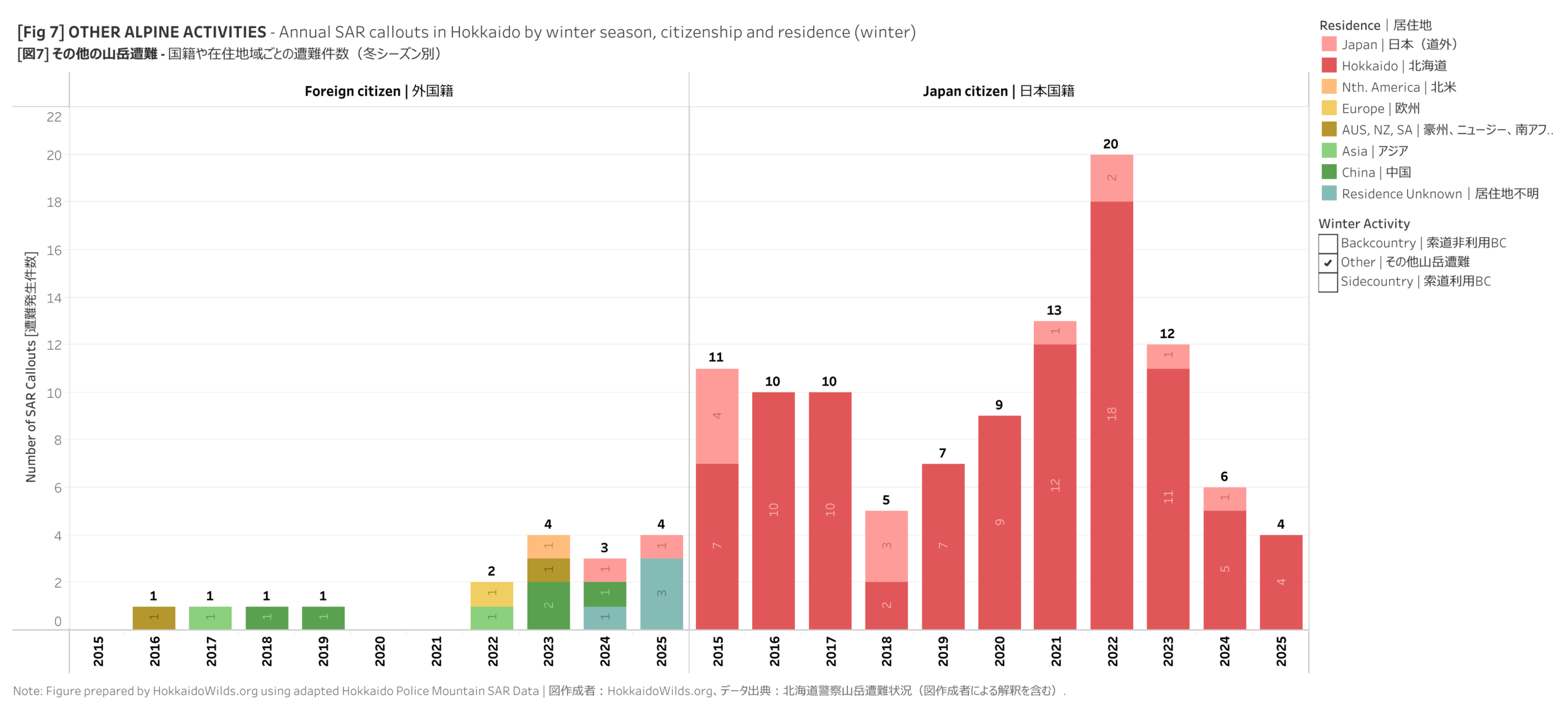


Getting lost is a main cause of non-skiing search and rescue callouts for Japanese


Outcomes of non-skiing search and rescue incidents are serious
VICTIM NUMBERS PER BACKCOUNTRY CALLOUT

Lift-access incidents are slightly more likely to be multi-victim events

SKI EQUIPMENT USED BY VICTIMS
Lift-access incidents are skewed towards snowboarders, non-lift-access towards skiers


There’s no clear trend in snowboard vs ski victim numbers

GUIDED VS NON-GUIDED BACKCOUNTRY INCIDENTS
Guided backcountry incidents are extremely rare


RESPONDING AGENCY DURING CALLOUT
Lift-access backcountry callouts keep ski patrol busy


Helicopters are involved more often in non-lift-access backcountry rescues

ABOUT THE DATA
We take our hats off to the Hokkaido Prefectural Police for making very detailed search and rescue statistics available to the public. It’s all in Japanese, so here at HokkaidoWilds.org we periodically convert the Hokkaido Police PDFs into a database, add English translations, and make that data available in Excel format as well as in our data browser.
Categories of mountain SAR incidents
Hokkaido police distinguish between two main categories of winter mountain search and rescue incidents.
- Backcountry Ski SAR Incidents (バックカントリースキー遭難)
These SAR incidents are ones where the individual(s) entered mountains with the intention of skiing or snowboarding or similar. Until around 2019, these incidents were further split up into the sub-categories of Ski Mountaineering Incidents (スキー登山遭難; non-lift-access backcountry) and Ski Search and Rescue Incidents (スキー遭難; lift-access backcountry). Hokkaido Police have since abandoned these two subcategory of ski-related incidents. Therefore, we have categorized each incident into those two sub-categories ourselves, using the incident descriptions supplied by the police. - Non-backcountry Ski Mountain Search and Rescue Incidents (バックカントリースキー遭難以外の山岳遭難) – These encompass all other mountain search and rescue incidents, both summer (hiking, climbing etc) and winter (such as ice-climbing, winter non-ski mountaineering etc).
Incident Description Content Categorization
Using the incident description text provided for each incident, we did our own coding for the following content categories. This coding was done with a mix of automated coding plus human and AI checks. For automated coding, we used Excel formulas to code the content based on keywords present in the descriptions (see those formulas here). We then asked ChatGPT to check the categories against what our first-pass Excel formulas decided, flagging any categories that appeared not to match the content. We then human-checked the flagged codes.
- Activity
- Lift-access Backcountry
- Non-lift-access Backcountry
- Other Winter Mountaineering
- Equipment used
- Ski
- Snowboard
- Other
- Responding agency
- Disaster SAR Helicopter
- Fire Dept Helicopter
- Police Helicopter
- Ski patrol
- Police Mountain SAR
- Fire Dept
- Ropeway Staff etc
- Other



8 thoughts on “Hokkaido Winter Search and Rescue Trends (2015-2025)”
Pingback: NEW POST TEST - HOMEPAGE
Thank you! Amazing work! This kind of access to information and discussion is much needed and respected for all of us snow riding and enjoying adventuring here in Hokkaido. The outdoor community awareness and participation you have started and keep on enhancing is so enlightening and important!
This is very impressive work and very helpful data. I was wondering if you have the incident type by specific location to drill further on the analysis of Avalanche incidents in specific zones over the last 10 years
Great article. It surprises me that there’s not more people requiring rescues in the back country when you look at the terrain and all the hazards vs the numbers of people that are inexperienced without the correct equipment and solo.
At a guess I would think most other countries with extreme terrain would have similar numbers requiring resources
Amazing analysis and data provided. Thanks for that as so much is provided in Japanese and impossible for non-speakers to find.
Glad to hear it’s useful Julia.
Thanks heaps for all your hard work in putting this together, truly impressive amount of detail and great explanations.
Cheers Robert!