
We’ve hiked (and skied) around the caldera rim of the expansive Ohachidaira Crater numerous times. It always leaves us in awe of the power of the eruptions and erosion that shaped it tens of thousands of years ago.


Something that always catches our eyes when visiting the area is the Yudoku-onsen (hotspring) 有毒温泉 mark on the Japan government topomaps. Literally, it means “poison hot spring”. I figured it was about time we make a blog post about this curious-looking hot spring.
According to some old (Uzumasa et al., 1959 as cited in Munakata et al., 2022) research papers, the water flowing from the hotspring itself is about perfect as far as hot springs go. A 1958 measurement recorded the spring at 48℃ with 252mg/l of dissolved sulfide. Chemically speaking, this is about perfect for a “medicinal” sulfur onsen in Japan—if it weren’t for the gas.
Concerning, however, are the numerous low-temperature gas vents that dot the floor of the crater. Unlike elsewhere (such as Hell’s Valley 地獄谷 on Asahidake), the fume vents of Ohachidaira Crater are low-temperature, meaning they often emit no visible gas at all. The volcanic gas they release is extremely rich in hydrogen sulfide—10–20% of the gas is H₂S according to a 1959 analysis (Iwasaki et al., 1959). Because H₂S and CO₂ are heavier than air, these gases accumulate in hollows and depressions on the crater floor, forming invisible pockets of toxic air. This pooling effect is particularly dangerous in very still weather.
Indeed, there have been at least two fatal incidents involving hikers who have hiked into the crater. One in July 1958 (two university students), and another in June 1961 (also two university students) (source). Both groups were overcome suddenly by gas on the crater floor. The accidents occurred in calm, windless conditions.
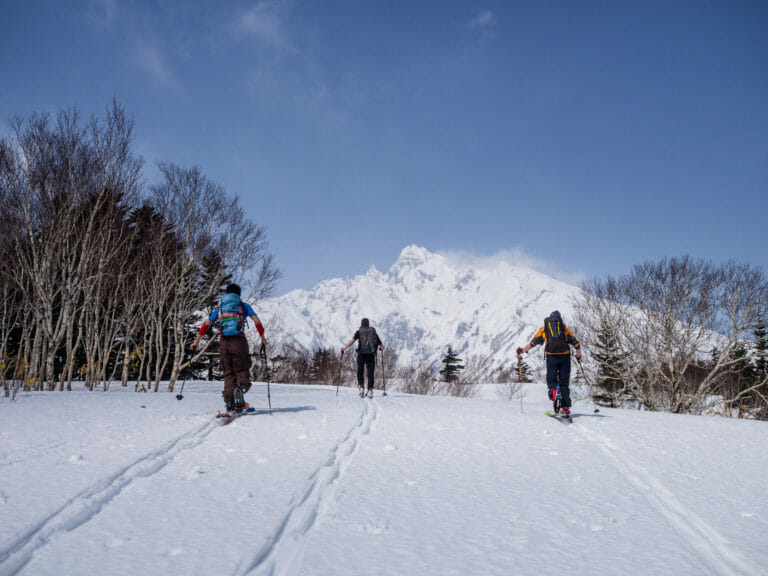
With no summer trail into the crater, it’s unlikely hikers will find themselves in danger. Adventurous skiers, willing to make the trek across the high Daisetsuzan Plateau, however, need to be careful. While not marked as such on Japan government topographical maps, the Daisetsuzan National Park designates the crater floor as a no-entry volcanic hazard zone.

Being part of the landscape, the poisonous Yudoku-onsen is also marked on our Daisetsuzan Backcountry map. In hindsight, given that us skiers do not limit ourselves to summer hiking trails, we probably should have marked the crater as hazardous (thanks to Richard from Adventure Hokkaido for the suggestion…unfortunately only just too late to make it into the printed map). Future updates will fix this, and in the meantime, we’ve added a warning to the digital version of the map.

That said, it is possible to ski some of the way down into the Ohachidaira Crater, as evidenced by this blog post from Shugakuso employee Soju-san. We’ve even heard reports of people camping in the crater back in the day. In reality, the safest option is simply not to descend into the crater at all. If you can ski down into it, that means gas can pool there. Wind direction, strength, and even small terrain depressions determine whether the air is safe—and these conditions can change in minutes. A simple rule: if you’re descending into the crater, you’re entering a gas trap.
In any case, there’s no pool at Yudoku Onsen to soak in—unlike Nakadake Onsen (see that overnight ski tour here), this is not a bathable spring. Realistically, anyone wanting to safely venture onto the crater floor would require industrial-level breathing gear (SCBA) and gas monitoring equipment. In other words: don’t go there.